About Lyme Disease
GLA Funded Research
Apply for Funding
Global Lyme Alliance's (GLA) grant application process consists of two stages:
All LOIs must be submitted through the GLA Application Portal.
GLA is the leading 501(c)(3) dedicated to combating Lyme and other tick-borne diseases through innovative research, awareness, and empowering the patient voice. GLA supports high-quality, evidence-based, and data-driven research that advances scientific knowledge and contributes to improving patient outcomes.
GLA prioritizes research that accelerates the development of innovative diagnostics, elucidates disease mechanisms, and advances novel treatment strategies for Lyme and other tick-borne diseases. A particular emphasis is placed on understanding and addressing post-treatment and chronic manifestations of Lyme disease.
2026 GLA Research Topic Areas
1. Diagnostics
GLA supports research aimed at developing accurate diagnostic tools for Lyme and other tick-borne diseases. Priority areas include:
Early detection methods that improve specificity and sensitivity, particularly in differentiating active infection from past exposure, and in identifying patients who may not present with hallmark signs such as erythema migrans lesions.
Biomarker discovery for identification of infection-associated chronic manifestations of Lyme disease, including the diagnosis of individuals with post-treatment Lyme disease symptoms (PTLDS).
Imaging, molecular, and serological approaches for disease identification and progression monitoring.
2. Disease Mechanisms
GLA seeks to advance understanding of the biological processes that drive infection, immune dysfunction, and neuroinflammation in Lyme disease and PTLDS. Areas of interest include:
The immunopathogenesis of Lyme disease, including host immune responses and mechanisms of immune evasion by Borrelia burgdorferi.
The role of neuroinflammation in neurological and cognitive symptoms associated with PTLDS.
The development of robust animal models that replicate the clinical, molecular, and immune features of PTLDS to facilitate mechanistic, therapeutic, and diagnostic studies.
3. Novel Treatment Strategies
GLA prioritizes research into innovative therapeutic approaches aimed at improving patient outcomes, with a focus on:
Drug repurposing and novel antimicrobial strategies.
Therapies aimed at mitigating dysregulated immune responses.
Precision medicine approaches that tailor treatments based on patient-specific factors like genetics and immune profiles.
Strategies designed to reduce infection risk or mitigate disease following tick exposure.
4. Epidemiologic Studies
GLA supports epidemiologic research to improve the understanding of Lyme and tick-borne disease prevalence, risk factors, and disease burden across diverse populations. Key areas include:
Population-based studies to assess the incidence, geographic distribution, and long-term outcomes of Lyme and other tick-borne diseases, including post-treatment and chronic manifestations.
Identification of environmental and genetic factors contributing to disease susceptibility and severity.
Investigations into co-infections with other tick-borne pathogens and their impact on disease progression and treatment response.
5. Biobanks and Sample Repositories
GLA recognizes the critical need for well-characterized biological samples to advance Lyme disease research. Efforts are focused on:
Establishing and expanding biobanks that include well-annotated patient and control samples, such as blood and cerebrospinal fluid to support diagnostic and therapeutic research.
Developing standardized protocols for sample collection, processing, and storage to ensure data quality and reproducibility across studies.
Facilitating data-sharing and interdisciplinary collaboration by integrating biobanked samples with clinical, molecular, and genetic datasets for comprehensive analyses.
GLA encourages interdisciplinary collaborations and the use of cutting-edge technologies to drive transformative discoveries in Lyme disease research.
The principal investigator (PI) on applications should typically hold a PhD, MD, or other advanced degree relevant to the research proposal. Graduate students are not eligible to serve as PI on these awards. Patient-led applications without an eligible PI are not accepted.
Applicants qualify for the Early Career Research Grant if they: 1) Are within 10 years of completing their terminal research degree or clinical training at the time of application; 2) Hold, or have a confirmed offer for, an independent academic or research appointment; 3) Have not previously served as PI on a major independent research award intended to support a sustained research program (e.g., NIH R01 or equivalent). The following do not affect eligibility: NIH R21, R03, or K-series awards; pilot, seed, or exploratory grants; fellowships or mentored awards; institutional or departmental funding; smaller foundation grants. Extensions to the 10-year eligibility window may be granted for family caregiving, medical leave, disability, military service, or other significant career interruptions.
All awards are limited to a 2-year project period and stated maximum budget unless otherwise discussed.
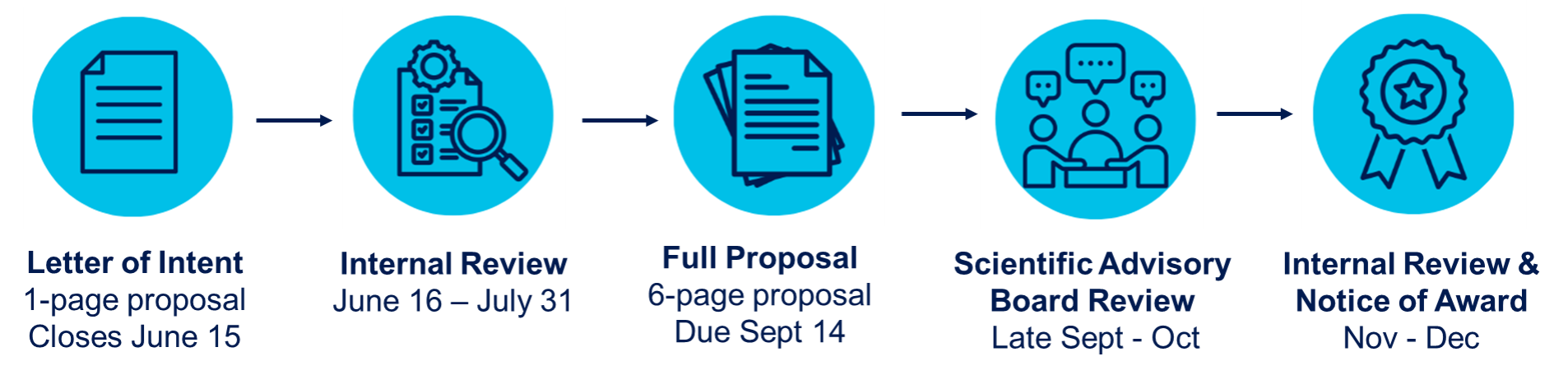
Anticipated Grant Start Date: February 15, 2027 (pending execution of grant agreements).
*Timeline is subject to change depending on application volume or other circumstances
Please download and complete the LOI template available here. LOIs must be one page, single-spaced, using Arial 11-point font with 0.5-inch margins. The following sections must be included:
All LOIs must adhere to these guidelines for consideration and be submitted through the GLA Application Portal.
GLA will accept proposals with multiple PIs. However, one individual must be designated as the contact PI, who will serve as the primary point of communication. If selected for full application and funded, it will be awarded to the contact PI’s institution, which will be responsible for issuing subawards to the other PIs, as appropriate.
Applicants are strongly encouraged to contact GLA at grants@gla.org with any questions or technical issues well in advance of the submission deadline. GLA may not be able to accommodate inquiries received on or after the submission deadline.
GLA conducts a programmatic review of LOIs to identify those with the strongest alignment to the 2026 Research Topic Areas and the greatest potential for feasibility and impact. Invited applicants must submit applications through the GLA Application Portal. Word, PDF, or Excel files are accepted for each section.
Lay-language abstract: Describe your proposed project in ≤ 200 words using nontechnical language and avoiding the use of acronyms (i.e., at a level that a ninth-grade student would understand).
Technical abstract: Describe your proposed project in ≤ 200 words using language commonly found in peer-reviewed publications and NIH grant proposals.
Include biographical sketches of the PI and all key personnel referenced in the budget. A biosketch modeled on the NIH format is preferred and highly encouraged.
The total length must not exceed 6 pages (excluding abstracts, references, and appendices). Project descriptions exceeding 6 pages will not be reviewed. Please organize your project description in the following sequence. Suggested page limits are flexible, but the total must not exceed 6 pages:
Required Format: Applications must be in English, with single-spaced text using Arial 11 or larger point font, and 0.5-inch margins.
List of references, uploaded in a separate field during submission
Provide a detailed budget and justification, including staff needs and itemized supplies. If applicable, include subaward budgets with appropriate justification. Facilities and Administrative (F&A) costs (indirect costs) are limited to 10% of direct costs and are added on top of direct costs. F&A costs are not included within the direct cost limits. (Example: $100,000 direct costs + $10,000 F&A costs (10%) = $110,000 total funds requested). For proposals over one year, include a budget for each year.
Permissible direct costs include:
Impermissible costs:
All awarded funds must be used solely for the purposes described in the approved application and budget. Note that budgets are sometimes reduced below the amount requested based on availability of funds and the scientific and programmatic merit of proposals.
Career Development & Independence Statement (Early Career Research Grant applicants only): Briefly describe your career trajectory, current stage of independence, and how this award will support your transition to research independence.
Letter of Institutional Support (Early Career Research Grant applicants only): A letter from a department chair, division chief, or institutional official confirming the applicant’s position, commitment of protected research time, and access to necessary resources and infrastructure to successfully complete the proposed project.
Letters of support and other material: If applicable, include letters of support from collaborators describing their contribution and commitment to the study. The applicant is also encouraged to share PDF versions of any prior publications whose findings are directly relevant to the submitted research proposal. Materials may be combined into one PDF file to facilitate uploading.
When the proposed research includes vertebrate animals, describe the involvement of live vertebrate animals according to the following criteria: (1) description of proposed procedures involving animals, including species, strains, ages, sex, and total number to be used; (2) justifications for the use of animals versus alternative models and for the appropriateness of the species proposed; (3) interventions to minimize discomfort, distress, pain and injury; and (4) justification for euthanasia method if NOT consistent with the American Veterinary Medical Association (AVMA) Guidelines for the Euthanasia of Animals.
For research that involves human subjects but does not involve one of the categories of research that are exempt under 45 CFR Part 46, describe the justification for involvement of human subjects and the proposed protections from research risk relating to their participation according to the following five review criteria: 1) risk to subjects; 2) adequacy of protection against risks; 3) potential benefits to the subjects and others; 4) importance of the knowledge to be gained; and 5) data and safety monitoring for clinical trials.
For research that involves human subjects and meets the criteria for one or more of the categories of research that are exempt under 45 CFR Part 46, describe: 1) the justification for the exemption; 2) human subjects involvement and characteristics; and 3) sources of materials.
A statement and assurances regarding potential biohazards and safeguards must be included.
If applicable, briefly describe methods to ensure the identity and validity of key biological and/or chemical resources (maximum one page). These include reagents or samples that may vary between labs or over time and are crucial to the research, such as cell lines, antibodies, and patient samples. Standard lab reagents like buffers or growth media need not be included.
The signature page must be completed before submission. Signatures from the PI and an authorized institutional representative are required.
Applications will be reviewed by members of GLA’s Scientific Advisory Board (SAB) using the following criteria:
Significance. Does the project address a key problem or barrier in the field? Will the outcomes advance scientific knowledge, tools, treatments, or clinical practice?
Innovation. Does the project propose novel ideas, methods, or tools that shift current research or clinical practice? Does it offer improvements or new applications?
Impact. Proposed research should generate high-impact data with clear potential to advance scientific knowledge, therapeutic development, or clinical care. Projects must demonstrate how outcomes could improve patient health in the short or long term. Priority will be given to studies that:
Provide a strong foundation for future research or funding;
Address critical gaps in knowledge or treatment;
Have translational potential to improve patient outcomes.
Investigators. Are the PI and team qualified and appropriately experienced? Do collaborative teams have complementary expertise and sound leadership?
Approach. Are the strategies and methods appropriate to achieve the aims? Are challenges, alternatives, and success metrics addressed?
SAB members will score these sections using a scale of 1-9, with 1 being the highest score (exceptional) and 9 the lowest (poor). This standardized scoring system allows reviewers to assess the overall impact and quality of each proposal.
Animals. The committee will evaluate the proposed use of live animals based on the procedures described, justification for choosing animals over alternative models, measures to minimize discomfort and pain, and the euthanasia method if not in line with AVMA Guidelines.
Budget. The committee will review the proposed budget for clarity and alignment with project goals. This includes evaluating staff compensation, supplies, and any sub-award budgets. The budget should reflect the appropriate use of requested funds to achieve project outcomes.
Biohazards and Authentication of Key Resources. Reviewers will assess any potential hazards posed by materials or procedures to research personnel and the environment, as well as the proposed protective measures. Additionally, for projects involving key biological or chemical resources, the review will include the adequacy of plans to authenticate and ensure the validity of these resources.
For Administrative and Scientific Inquiries Contact: grants@gla.org